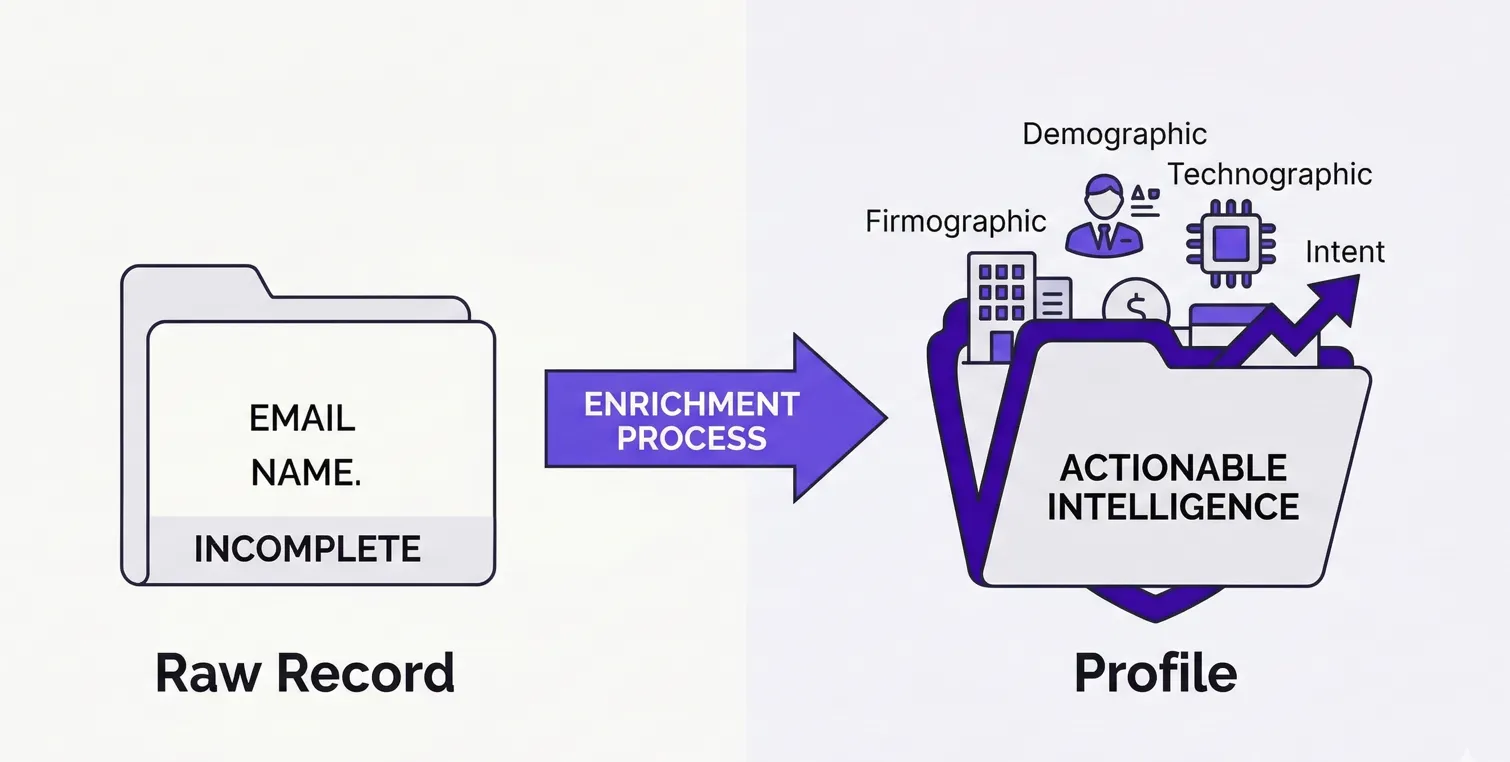

Lead enrichment is the automated process of appending verified, structured data to raw contact records, transforming incomplete prospect profiles into actionable intelligence.
It pulls in firmographic data, demographic attributes, technographic signals, direct contact details, and behavioral context from external sources.
In 2026, lead enrichment sits at the center of GTM execution: it feeds lead scoring models, powers CRM hygiene, enables personalized outreach, supports ABM targeting, and drives pipeline velocity.
Without lead enrichment, workflows that depend on contact intelligence, including routing, segmentation, nurture sequencing, and sales qualification, all operate on incomplete inputs.
This guide covers what lead enrichment is, how waterfall enrichment works, the types of enrichment data available, how each GTM persona benefits, what a lead enrichment API does, how to evaluate platforms, common mistakes, and the compliance considerations every B2B team needs to understand.
What Is Lead Enrichment?
Lead enrichment is the automated process of supplementing basic lead records with additional verified data pulled from external sources. When a prospect fills out a form, submits a demo request, or gets added to a CRM, they often provide minimal information: a name, an email, sometimes a company name. Lead enrichment fills in the rest.
The goal is to turn a partial record into a complete prospect profile that includes everything a sales rep or marketer needs to qualify the lead, personalize outreach, route it correctly, and score it accurately.
At its core, lead enrichment answers the questions a raw record cannot: Who is this person? What do they do? What kind of company do they work at? Are they worth pursuing right now?
Lead enrichment operates through integrations that connect your CRM or sales platform to one or more external data providers.
When a trigger fires, whether a form submission, a new contact added, or a scheduled batch run, the enrichment system queries its data sources, validates what it finds, and writes the results back to the record automatically. The best platforms do this in real time, before the lead ever reaches a sales rep's queue.
What Is the Difference Between Lead Enrichment and Data Enrichment?
Data enrichment is the broader term. It refers to the process of appending any type of external data to any type of record, including company records, product records, customer accounts, or operational datasets. Lead enrichment is a specific application of data enrichment focused on prospect and contact records within a sales and marketing context.
In practice, the terms are often used interchangeably in B2B sales conversations, but the distinction matters when evaluating tools. A pure data enrichment platform may support a wide range of record types and data formats. A lead enrichment platform is purpose-built for contact and company enrichment within GTM workflows.
Why Does Lead Enrichment Matter in 2026?
The B2B market moves faster than static databases can keep up with. Companies rebrand, merge, and shut down. Decision-makers change roles. Phone numbers go inactive.
An email address that was valid six months ago may already be bouncing. Buyers today are further into their research before they ever engage with a sales rep, which means the window for a relevant first interaction is smaller than ever.
Lead enrichment matters because it closes the gap between the data sales and marketing teams have and the data they need to act decisively. Three specific pressures make it non-negotiable in 2026.
Email deliverability thresholds have tightened: Gmail and Outlook penalize senders with bounce rates above 2%. Sending to unvalidated email addresses damages domain reputation and reduces inbox placement across all future campaigns. Enrichment platforms that validate email deliverability before a record enters a sequence protect sender reputation at scale.
Personalization has become a baseline expectation. Prospects receive dozens of outbound messages per week. Generic outreach that demonstrates no knowledge of the recipient's role, company, or context is ignored. Enriched profiles give reps the job title, company stage, industry, and technology context they need to write a first line that earns a response.
GTM teams are doing more with fewer resources. SDR teams are smaller. Marketing budgets face greater scrutiny. RevOps is asked to maintain data quality across a growing tech stack without proportional headcount. Automated lead enrichment removes manual research from every rep's workflow, reclaiming hours that go directly into outreach activity and pipeline generation.
What Are the Types of Lead Enrichment Data?
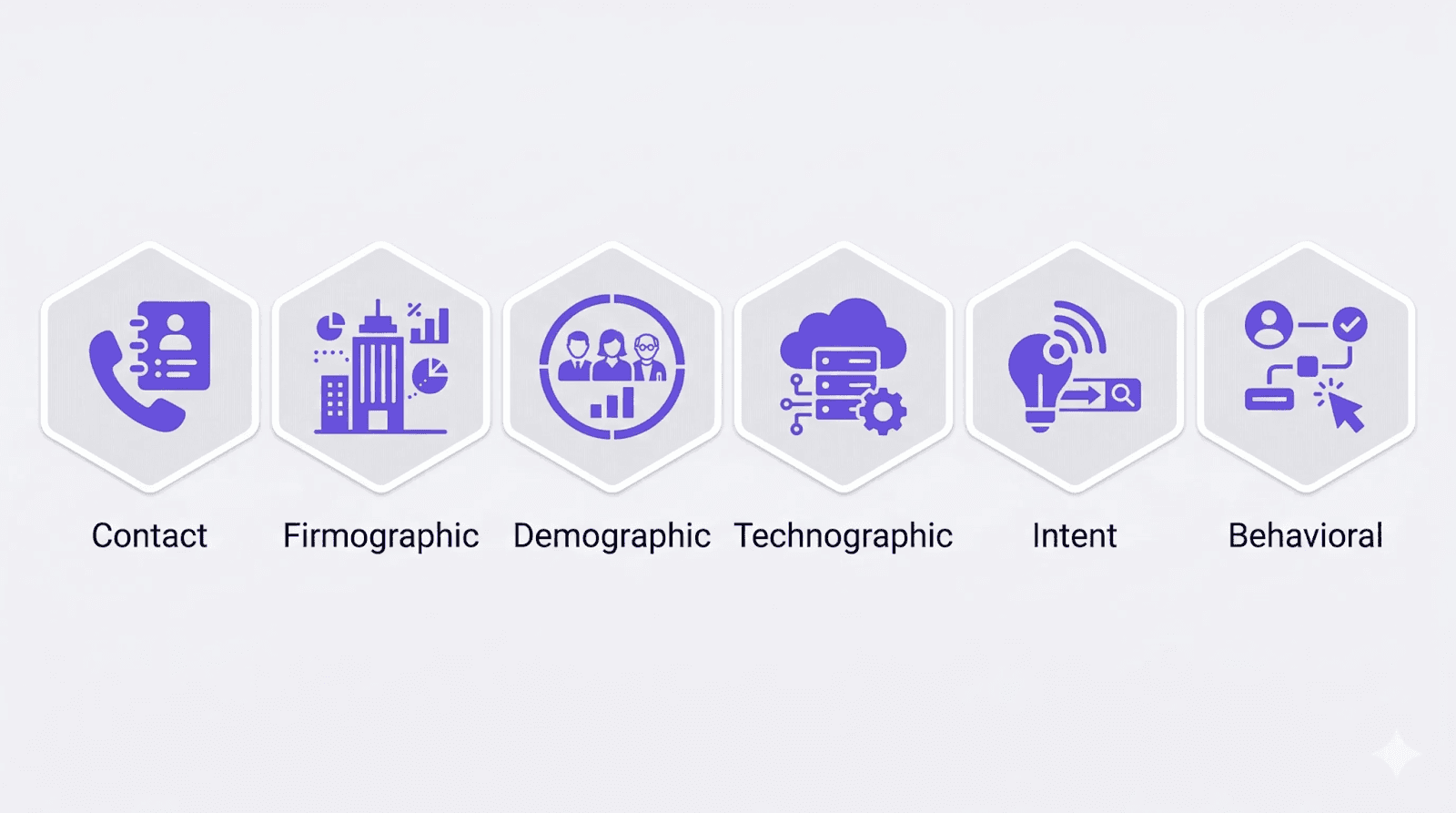
Lead enrichment pulls from 6 data categories. Each category serves a specific function in helping GTM teams qualify, prioritize, and engage the right prospects.
Data Type | What It Includes | Primary Use |
Contact Data | Work email, personal email, mobile phone, LinkedIn URL | Direct outreach and engagement |
Firmographic Data | Company size, revenue, industry, location, company type | ICP matching and account prioritization |
Demographic Data | Job title, department, seniority, management level | Role-based personalization, decision-maker identification |
Technographic Data | CRM used, marketing automation, infrastructure tools | Integration fit and competitive positioning |
Intent Data | Research signals, content consumption, competitive analysis | In-market account identification |
Behavioral Data | Website visits, email opens, content downloads, event attendance | Engagement scoring and warm lead prioritization |
1. Contact Data
Contact data is the most immediate output of lead enrichment and the most directly tied to outreach execution. It includes work email addresses, personal email addresses, mobile phone numbers, and LinkedIn profile URLs. Without verified contact data, everything else is academic. The lead cannot be reached.
Work emails follow predictable formats tied to company domains but expire when someone leaves a role. Personal emails persist through job changes and are particularly valuable for recruiting workflows and for reaching prospects whose corporate inbox filtering is aggressive.
Mobile numbers dramatically increase connect rates compared to office lines, which are frequently unmanned or gated through assistants.
2. Firmographic Data
Firmographic data describes the prospect's organization. Company size measured by headcount, annual revenue range, industry vertical, company type (private or public), geographic location, founding date, and LinkedIn company URL all fall into this category.
Firmographic data is the primary input for ICP matching. It determines whether an account structurally qualifies as a target before a rep spends a single minute on outreach. A company with 12 employees in a non-strategic industry is a different conversation than a 400-person SaaS company at Series C, even if the two contacts share the same job title.
3. Demographic Data
Demographic data describes the contact's professional identity within their organization. Job title, department, seniority level, years in role, and management responsibility all contribute to understanding whether this person is a decision-maker, an influencer, or an end-user. This distinction determines the tone, the angle, and the CTA of any outreach sequence.
4. Technographic Data
Technographic data reveals which software and infrastructure tools a company currently uses. Knowing that a prospect runs Salesforce as their CRM and Outreach for sales engagement tells a data enrichment platform exactly which integration pain points are most likely to resonate. It also reveals whether they are already a customer of a competitor, whether they are a natural fit for your product's integration ecosystem, and what their technical sophistication level is likely to be.
5. Intent Data
Intent data surfaces accounts that are actively researching topics related to your product category. It is derived from content consumption signals, third-party research behavior, competitive analysis activity, and review site visits. An account that has visited G2 comparison pages for data enrichment tools three times in the past week is a warmer target than an account that matches your ICP but shows no behavioral signal.
6. Behavioral Data
Behavioral data captures how a specific contact has interacted with your owned channels. Website visits, email opens, content downloads, webinar registrations, and event attendance all generate behavioral signals that, combined with firmographic and demographic fit, produce an accurate picture of where a lead sits in their buying journey.
How Lead Enrichment Works: The Waterfall Model Explained
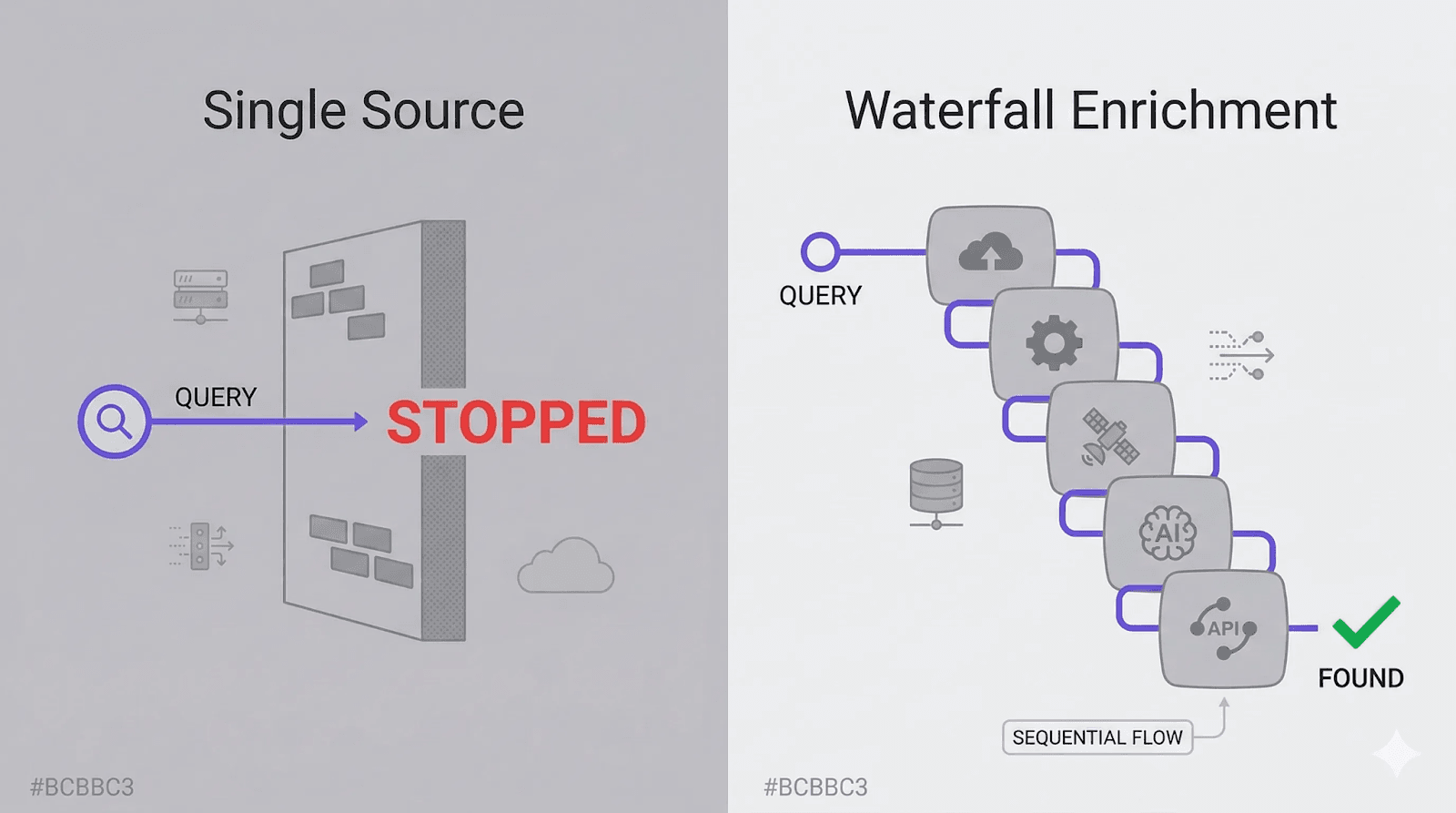
Every lead enrichment platform follows a basic process: receive an input, query a data source, validate a result, and return enriched data. The critical variable is how many data sources are queried and in what order.
Single-source enrichment queries one proprietary database. If that database has the record, enrichment succeeds. If not, the query fails and in many cases the platform still charges for the attempt. Single-source platforms perform well for the profiles their database covers well and poorly for everything else.
Waterfall enrichment sequences queries across multiple data providers in order, moving from one to the next until a verified result is found. This approach was designed specifically to address the coverage limitations of any single database.
Because different providers have different coverage strengths by geography, company size, industry, and role type, stacking them fills the gaps that any single provider would leave, producing materially higher match rates for teams enriching contacts in niche industries, smaller company sizes, international markets, or role types that a single database covers poorly.
The 5-Step Lead Enrichment Process
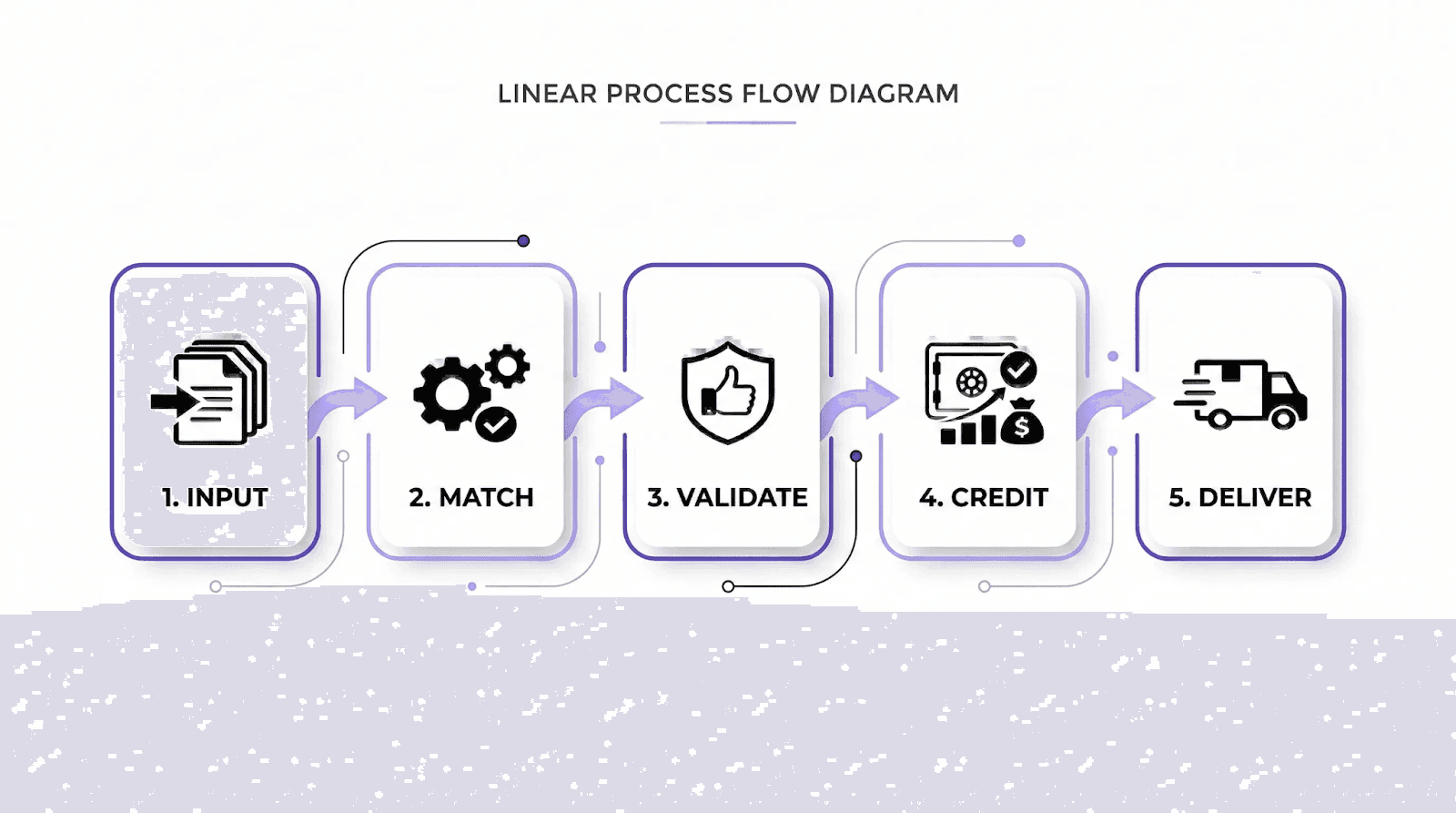
Whether running through a single provider or a waterfall stack, the enrichment process follows five consistent stages.
Step 1: Input Submission
A raw data point enters the system: a name plus company domain, a LinkedIn profile URL, a CSV file upload, or an API trigger from a CRM workflow. Strong enrichment platforms accept all four input methods, plus reverse email lookup via API for inbound enrichment workflows.
Step 2: Source Matching
The enrichment engine queries its data sources against the input. In a waterfall model, providers are queried sequentially based on their known coverage strength for the record type and geography.
Step 3: Real-Time Validation
When a candidate email is found, it goes through deliverability verification against live mail server records. Phone numbers are checked against carrier databases. Records that fail validation are not returned, and no credit is consumed for failed lookups on platforms with success-only billing.
Step 4: Credit Allocation
Platforms with sound pricing models charge a credit only when enrichment succeeds and returns a verified result. If the waterfall exhausts all providers without finding a valid contact, the query costs nothing. This model ensures teams pay for outcomes, not attempts.
Step 5: Data Delivery
The enriched profile is written back to the CRM, delivered via API response, or returned in the enriched CSV depending on the workflow configuration.
Who Benefits from Lead Enrichment and How?
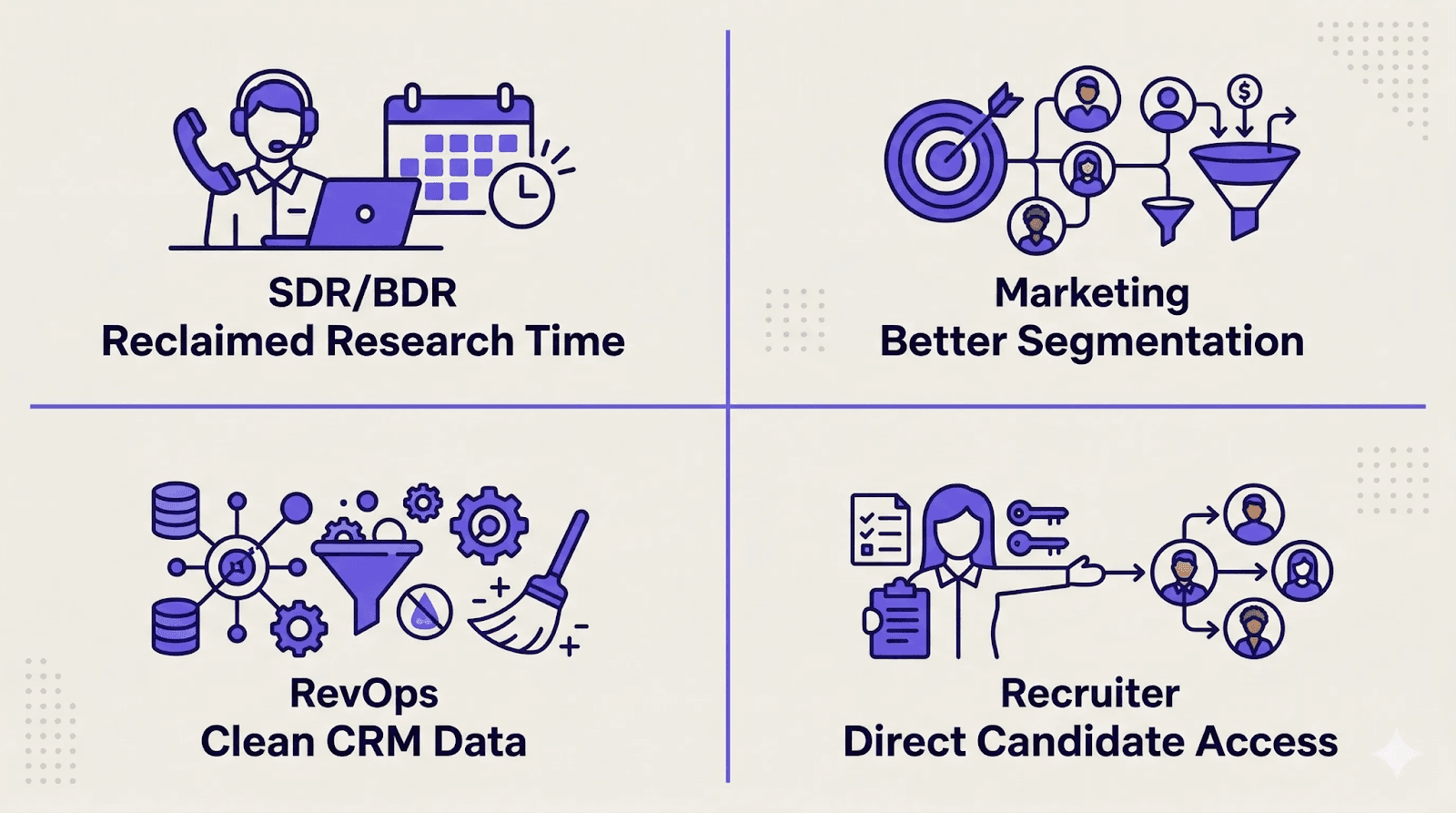
Lead enrichment serves every team in a B2B GTM organization, but each team extracts a different type of value from it, as discussed below:
SDRs and BDRs
SDRs and BDRs use lead enrichment to build verified outreach lists without manual research. The traditional process of opening a LinkedIn tab, searching for a prospect, finding their company page, guessing their email format, and verifying it manually takes 5 to 10 minutes per contact.
For a rep building a 100-contact sequence, that is 8 to 16 hours of research time that produces zero pipeline.
With enrichment, that same rep uploads a CSV of names and domains, runs enrichment, and returns to a fully populated file with verified emails, mobile numbers, job titles, and company data. The reclaimed research time goes directly into personalized outreach activity and booked meetings.
Marketing and Demand Gen Teams
Marketing teams face a specific problem: inbound leads arrive with minimal data. A prospect who fills out a webinar registration form submits their name and email. A prospect who downloads a content piece provides even less. Without enrichment, those leads reach the CRM as incomplete records that cannot be scored, segmented, or routed properly.
Lead enrichment runs automatically when a form is submitted, appending job title, company size, industry, and seniority before the record touches a workflow. The result is a qualified, scoreable contact that can be routed to the right SDR, entered into the right nurture sequence, and tracked against the right attribution model from day one.
Enriched leads also dramatically reduce form length. Instead of asking prospects to fill in their job title, company size, and industry, marketing teams collect only the essentials and let enrichment fill the rest.
Research shows that reducing form fields from 11 to 4 can boost conversion rates by 120%. Shorter forms convert at higher rates, and enrichment delivers the missing data without adding friction to the submission process.
RevOps and SalesOps Teams
RevOps teams use lead enrichment as a CRM hygiene mechanism. Every B2B database decays at approximately 25 to 30% per year as contacts change jobs, companies get acquired, and email addresses expire. Without a continuous enrichment layer, a CRM that was clean at implementation becomes unreliable within 12 to 18 months.
Automated enrichment through API integration or scheduled batch runs keeps records current without manual intervention. It flags records that failed enrichment for manual review, deduplicates contacts that appear under multiple email formats, standardizes field values like job titles and company names to consistent formats, and enriches new inbound records before they enter any routing or scoring logic.
RevOps teams also use enrichment data to improve lead routing rules. A routing system that assigns leads based on company size and geography requires reliable firmographic data in every record. Enrichment ensures that routing rules fire correctly rather than defaulting to manual assignment when critical fields are empty.
Recruiters
Recruiters use lead enrichment to reach passive candidates who will not respond to a LinkedIn InMail. Finding a candidate's personal email address or direct mobile number bypasses the LinkedIn message queue entirely and produces dramatically higher response rates.
Dedicated enrichment platforms that surface personal contact information alongside professional data serve recruiting workflows directly.
Startup Founders and Small Teams
Founders and small teams use lead enrichment to skip the multi-tool complexity that larger organizations accept as standard. Instead of subscribing to three or four data providers at separate costs, managing separate APIs, and manually reconciling coverage gaps, they use a single platform that handles multi-source coverage automatically. Platforms with unlimited seat models mean an entire founding team shares one credit pool without per-head licensing fees.
How FullEnrich Approaches Lead Enrichment?
FullEnrich is a waterfall enrichment platform that aggregates 20+ premium data providers, including Apollo, Lusha, ZoomInfo, Hunter, Datagma, and ContactOut, and sequences queries through them until it finds and verifies a contact's email, phone, and firmographic data.
Rather than building or maintaining its own static database, FullEnrich fetches data on demand, which keeps match rates high across diverse industries, company sizes, and geographies where single-source tools frequently produce gaps.
Find rates reflect this architecture directly. FullEnrich reaches 89% email find rate for US contacts and 86% phone find rate, with EMEA at 84% email and 71% phone, LATAM at 78% email and 67% phone, and APAC at 78% email and 66% phone. Triple email verification keeps bounce rates below 1%, which protects sender reputation across all outbound sequences.
The credit model aligns cost with outcomes: a credit is consumed only when enrichment returns a verified result. Failed lookups cost nothing.
Unlimited user seats on all plans mean entire GTM teams share one credit pool without per-head licensing fees. Native integrations with HubSpot, Salesforce, Pipedrive, Google Sheets, Zapier, Make, and API access cover every major workflow configuration without engineering overhead.
Start enriching leads for free on FullEnrich
How to Evaluate a Lead Enrichment Tool: 6 Key Criteria
The best enrichment platform for one team may be wrong for another. Evaluation requires matching tool capabilities to specific workflow needs, geographic coverage requirements, and budget structures.
1. Match Rate and Coverage Depth
A vendor's headline match rate is only meaningful against your specific ICP. Request a coverage test using a sample of your actual prospect list before committing. Test both email and phone enrichment. Ask how coverage varies by geography, company size, and industry. A tool with 85% match rate on US mid-market SaaS may deliver 40% on European SMBs, and your pipeline may live in that second category.
2. Data Freshness and Validation
Ask how frequently the underlying data is updated and whether the platform fetches data on demand or serves it from a static cache. On-demand fetching produces fresher results. Platforms that store static databases update on a delay, which means the data returned may reflect a contact's role from 6 or 12 months ago.
Ask specifically about email validation methodology. A triple verification process that checks deliverability against live mail server records produces measurably lower bounce rates than simple format validation.
3. Pricing Transparency
Understand exactly what triggers a charge. Does an enrichment attempt consume a credit even if it fails? Do seat fees apply in addition to credits? Are there overage charges if monthly credit limits are exceeded? The total cost of enrichment at your target volume is often substantially higher than the plan's headline price when seat fees, overage charges, and failed-lookup costs are factored in.
4. Integration Ecosystem
Check whether the tool integrates natively with your CRM, sales engagement platform, and automation stack. Native HubSpot and Salesforce integrations reduce engineering lift. Zapier and Make compatibility extend coverage to teams with custom workflows. API access is essential for teams building product-embedded enrichment or running high-volume batch workflows programmatically.
5. Compliance Posture
For teams enriching contacts in Europe or handling data for EU-based prospects, GDPR compliance is not optional. The key distinction is between platforms that maintain a static database of personal contact records and platforms that fetch data on demand.
Static databases raise questions about consent at the point of collection, data residency, and the right to erasure. On-demand fetching aligns with data minimization principles and reduces compliance exposure. Confirm SOC 2 Type II certification, GDPR compliance documentation, and CCPA compliance before committing to any enrichment platform that will handle personal data.
6. Support for Multiple Enrichment Modes
The strongest enrichment platforms support both real-time and batch enrichment, as the two serve different workflow needs. Real-time enrichment runs on inbound triggers: form submissions, new CRM records, API calls.
It ensures leads arrive complete without delay. Batch enrichment processes existing databases, campaign lists, or historical records in bulk and is essential for CRM hygiene and territory planning.
How to Set Up a Lead Enrichment Workflow?
A well-designed enrichment workflow runs continuously in the background without requiring manual intervention. The following covers the four primary workflow types.
Inbound enrichment workflow: When a prospect submits a form, an API call triggers enrichment against the submitted name and email. Within seconds, the CRM record is populated with job title, company size, industry, and contact data. The lead is scored, routed to the appropriate SDR, and enrolled in the correct sequence, all before a human reviews the record.
Outbound list enrichment workflow: A rep or analyst uploads a CSV of target accounts with company domains. Enrichment runs across the list and returns a verified contact file with emails and phone numbers for each account. The enriched file is imported to the CRM or directly into a sales engagement sequence.
CRM backfill workflow: A RevOps team identifies all CRM records missing critical fields (job title, phone, company size). They trigger a batch enrichment run against those records. Results are written back to the CRM automatically. Records that fail enrichment are flagged for manual review or suppression.
Triggered re-enrichment workflow: When a contact record reaches a specific stage in the pipeline, enrichment runs again to verify data freshness before the rep makes contact. This is particularly important for deals with longer sales cycles where contact information may have changed between initial enrichment and close.
Common Lead Enrichment Mistakes That Kill Pipeline
Relying on a single data source: No provider covers every prospect with equal depth. A platform with strong US enterprise coverage may miss 40% of contacts in European SMBs or Asian markets. Single-source enrichment leaves predictable coverage gaps that undermine pipeline in specific segments. Waterfall enrichment addresses this by sequencing multiple providers, filling gaps in one with strength in another.
Paying for failed enrichment attempts: Several platforms charge a credit or fee for every enrichment query regardless of whether a valid result is returned. At scale, the cost of failed lookups adds up to a significant percentage of total spend. Platforms that only charge on successful enrichment produce more predictable costs and better economics per verified contact.
Not validating emails before sending: Finding an email address is not the same as verifying its deliverability. An email that is syntactically valid may still bounce if the mailbox has been closed, the domain has changed, or the address was misformatted at source. Enrichment without validation produces lists that damage sender reputation and reduce inbox placement rates.
Treating enrichment as a one-time event: Data decays at 25 to 30% per year. Contacts change roles, companies get acquired, and email addresses expire. Running enrichment once and never refreshing produces databases that drift steadily toward inaccuracy. Continuous enrichment through triggered re-enrichment and scheduled batch refreshes maintains data quality over time.
Ignoring compliance requirements: GDPR and CCPA impose specific obligations on how personal contact data is collected, stored, and processed. Platforms that maintain static databases of personal data may expose their customers to compliance liability depending on consent and data residency considerations.
Building enrichment without connecting it to scoring and routing: Enrichment that populates fields no workflow actually reads delivers no pipeline benefit. Every enriched field should feed at least one downstream action: a lead score attribute, a routing rule, a sequence personalization token, or a segmentation criterion. Map which fields drive which actions before selecting the enrichment fields to prioritize.
Lead Enrichment and Data Compliance: What Teams Need to Know
GDPR, CCPA, and PECR each impose distinct obligations on B2B teams that use enriched contact data for outreach. Compliance is not optional, and the approach an enrichment platform takes to data handling has direct implications for a customer's own compliance posture.
GDPR (EU/EEA): The General Data Protection Regulation requires a lawful basis for processing personal data. For B2B outreach, legitimate interest is the most commonly cited basis, but it requires a documented balancing test. GDPR also confers the right to erasure. If a contact requests that their data be deleted, the organization must honor that request, which is more complex when personal data is stored in a static vendor database versus fetched on demand.
CCPA (California): The California Consumer Privacy Act grants California residents the right to know what personal information is collected about them, to opt out of the sale of their data, and to request deletion. B2B contact data falls within CCPA's scope when the contact is a California resident.
On-demand fetching vs. static storage: Platforms that do not store personal data but instead fetch contact information on demand from their provider network return data directly to the requester without maintaining a central database of personal contact records. This architecture reduces the compliance surface area for both the platform and its customers. Competing platforms that build and maintain their own contact databases carry a different compliance posture, particularly for data collected from individuals in GDPR jurisdictions without explicit consent documentation.
Conclusion
Lead enrichment is the operational foundation that connects raw contact data to productive sales activity. Without it, the workflows that depend on contact intelligence, including lead scoring, CRM routing, personalized outreach, and ABM targeting, all operate on incomplete inputs and produce unreliable outputs.
The teams that build durable pipeline in 2026 act on the best data, fastest. That requires enrichment that is accurate, continuously refreshed, and tightly integrated into the tools that drive outreach and conversion.
Single-source platforms will always carry coverage gaps that surface at the worst possible time: when the prospect is real but the contact data is missing. Waterfall enrichment, built on a stack of multiple providers queried in sequence, is the architecture that closes those gaps systematically.
See how FullEnrich helps B2B teams enrich leads at scale
FAQs
What inputs does lead enrichment require?
Most platforms accept a name plus company domain, a LinkedIn profile URL, or a CSV file. Advanced platforms also accept direct API calls and support reverse email lookup, which takes an email address as the input and returns the full contact profile.
How accurate is enriched contact data?
Accuracy varies significantly by platform and geography. Platforms that validate emails against live mail server records and match phone numbers against carrier databases consistently produce lower bounce rates than those that rely on database-only verification. Triple email verification processes are designed to keep bounce rates below 1%.
What is the difference between real-time and batch enrichment?
Real-time enrichment processes a single record the moment it enters a workflow, typically triggered by a form submission or a CRM event. Batch enrichment processes a list of records in a single operation, used for CRM backfill, campaign list preparation, and periodic database hygiene. Strong enrichment platforms support both modes.
How does waterfall enrichment improve match rates?
Waterfall enrichment sequences queries across multiple data providers in order. If the first provider returns no result, the query passes to the second, then the third, and so on. Because different providers have different coverage strengths by industry, geography, and role type, stacking them fills the gaps that any single provider would leave.
Does lead enrichment work for international markets?
Yes, but platform selection matters significantly. US-centric single-source databases often have weak coverage in EMEA, APAC, and LATAM. Platforms that aggregate multiple providers, including those with regional coverage strength in specific markets, produce far higher match rates for international enrichment.



Other Articles
Cost Per Opportunity (CPO): A Comprehensive Guide for Businesses
Discover how Cost Per Opportunity (CPO) acts as a key performance indicator in business strategy, offering insights into marketing and sales effectiveness.
Cost Per Sale Uncovered: Efficiency, Calculation, and Optimization in Digital Advertising
Explore Cost Per Sale (CPS) in digital advertising, its calculation and optimization for efficient ad strategies and increased profitability.
Customer Segmentation: Essential Guide for Effective Business Strategies
Discover how Customer Segmentation can drive your business strategy. Learn key concepts, benefits, and practical application tips.