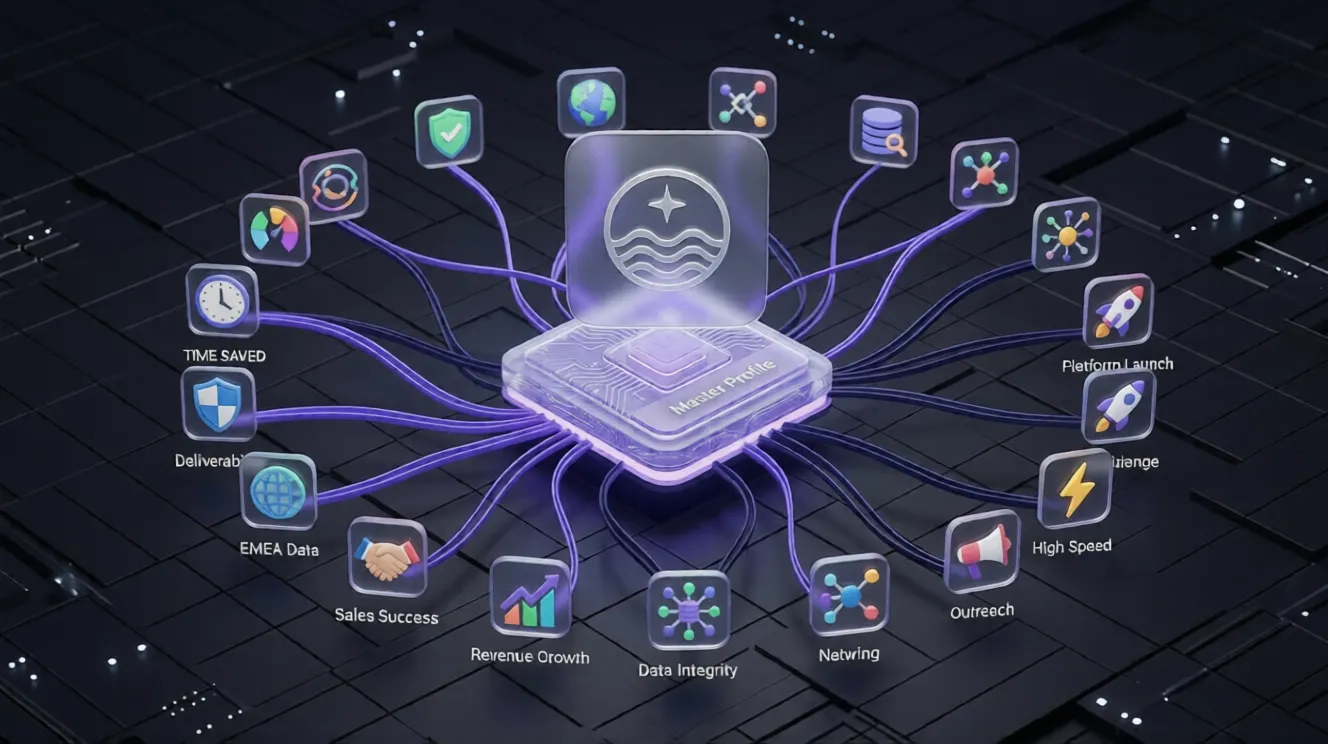

Data enrichment is the process of merging first-party CRM records with verified third-party intelligence to produce complete, actionable prospect profiles. A bare record with a name and email becomes a working buyer profile: current title, direct mobile, company revenue, technology stack, and intent signals.
The gap between those two states is where enrichment operates.
This is distinct from data collection. Enrichment does not generate new leads. It takes leads that already exist and fills in what is missing, what is wrong, and what has decayed since the record was first created.
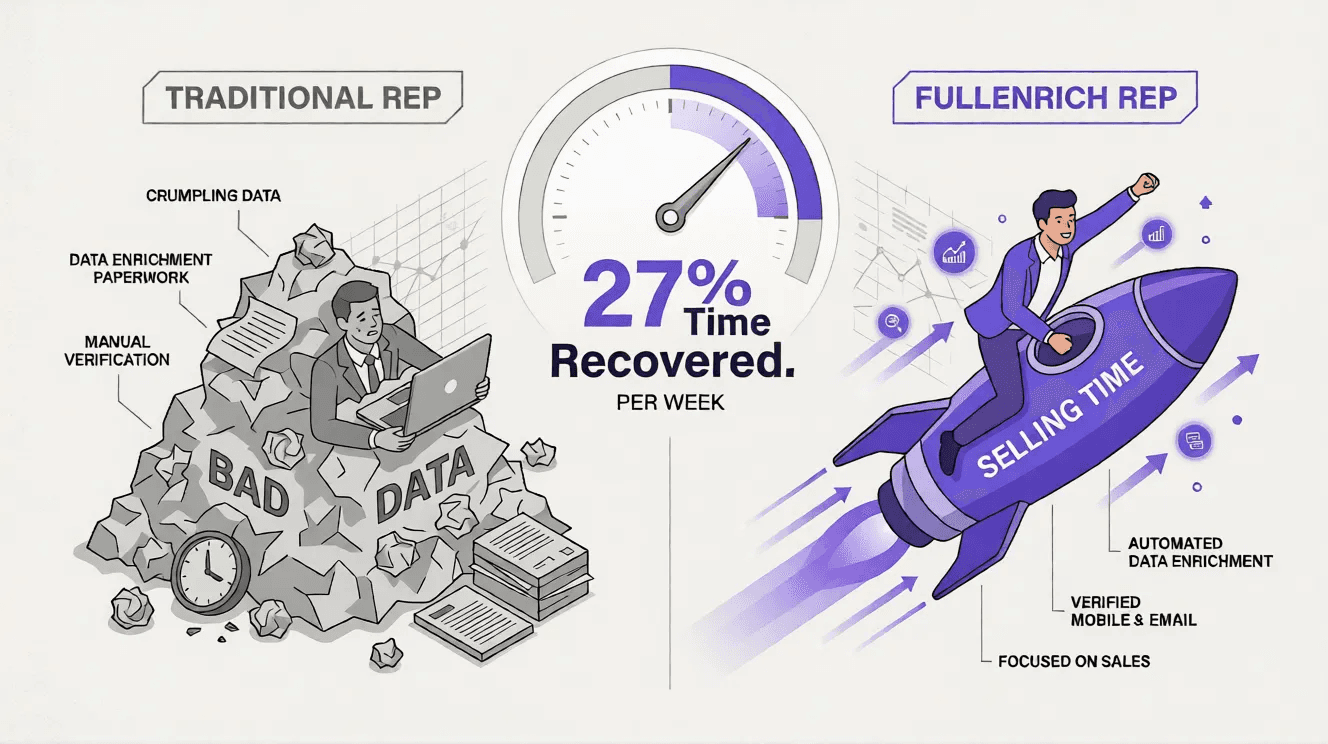
Gartner puts the annual cost of bad data at $12.9 million per organization.Similarly, ZoomInfo research shows sales reps waste over 27% of their time chasing inaccurate or incomplete records.
Those two figures describe the same problem from different angles: the cost shows up in the financials, but it starts on the rep's screen when a phone number disconnects or an email bounces.
Enrichment solves that at the source. This page covers what data enrichment adds to a record, the specific benefits across sales, marketing, and operations, and how to implement it effectively.
What Does Data Enrichment Add to a Record?
B2B data enrichment draws on four categories of data, each serving a distinct role in the go-to-market motion. Missing any one of them leaves a specific gap in how reps qualify, contact, and convert prospects.
Firmographic data covers the organizational basics: company size, annual revenue, industry classification, headquarters location, and growth stage. This layer determines ICP fit at the account level. A company with 20 employees does not buy the same way as one with 2,000. Without firmographics, the CRM cannot distinguish between them.
Professional and demographic data covers the individual: current job title, seniority level, department, verified work email, personal email, and direct mobile number. This is the contact layer. Correct firmographics without a working phone number or email address still leave the rep unable to reach anyone.
Technographic data maps what software and infrastructure a prospect already runs. Knowing whether a target account uses a direct competitor, a complementary platform, or outdated legacy tools is the difference between a generic pitch and a relevant one. Technographics make that distinction possible at scale.
Chronographic and intent signals capture timing. A recent funding round, a new VP hire, or active research behavior on third-party review sites all indicate a buying window. Without these signals, outreach is sent at the wrong time as often as the right time.
What Are the Benefits of Data Enrichment for Sales Teams?
Sales enrichment benefits concentrate in three areas: time recovery, contact quality, and deal velocity. A rep working from a complete, verified record moves faster and hits more often than one working from an incomplete one.
1. More selling time, less research time. Sales reps waste over 27% of their working hours chasing inaccurate or stale data, manually verifying titles, looking up phone numbers, and re-qualifying contacts who have already moved on. Automated enrichment at point of capture eliminates that loop before it starts.
2. Higher connect rates on outreach. Corporate switchboards increasingly route to voicemail. LinkedIn InMail reply rates are low. Enrichment surfaces verified personal emails and direct mobile numbers, giving reps a path to the decision-maker that bypasses filters and gatekeepers.
3. Stronger email deliverability. Sending to unverified or catch-all addresses raises bounce rates. High bounce rates trigger spam filters and degrade domain reputation. Real-time SMTP verification confirms each inbox is active before a send, keeping bounce rates below the 1% threshold that protects sender reputation.
4. Shorter sales cycles through multithreading. Deals stall when a single contact goes dark. Enrichment maps the full decision-making unit inside an account, giving reps alternative stakeholders to engage when the primary contact becomes unresponsive. Deals move instead of dying quietly in the pipeline.
5. Better-timed outreach through intent signals. Reaching a company in the middle of a vendor evaluation is entirely different from reaching the same company six months before budget season. Chronographic signals like funding rounds and leadership hires, combined with behavioral intent data, indicate when a prospect is actively considering a purchase.
6. Reduced rep burnout. Reps who dial correct numbers and reach real people hit their targets more often. Reps who spend their days on dead ends and bounced emails burn out faster. Accurate data is a morale input, not just a productivity one.
Start enriching your sales records with FullEnrich
What Are the Benefits of Data Enrichment for Marketing Teams?
Marketing benefits from enrichment differently than sales does. The gains show up in campaign efficiency, segmentation accuracy, and the quality of leads handed off to the sales team.
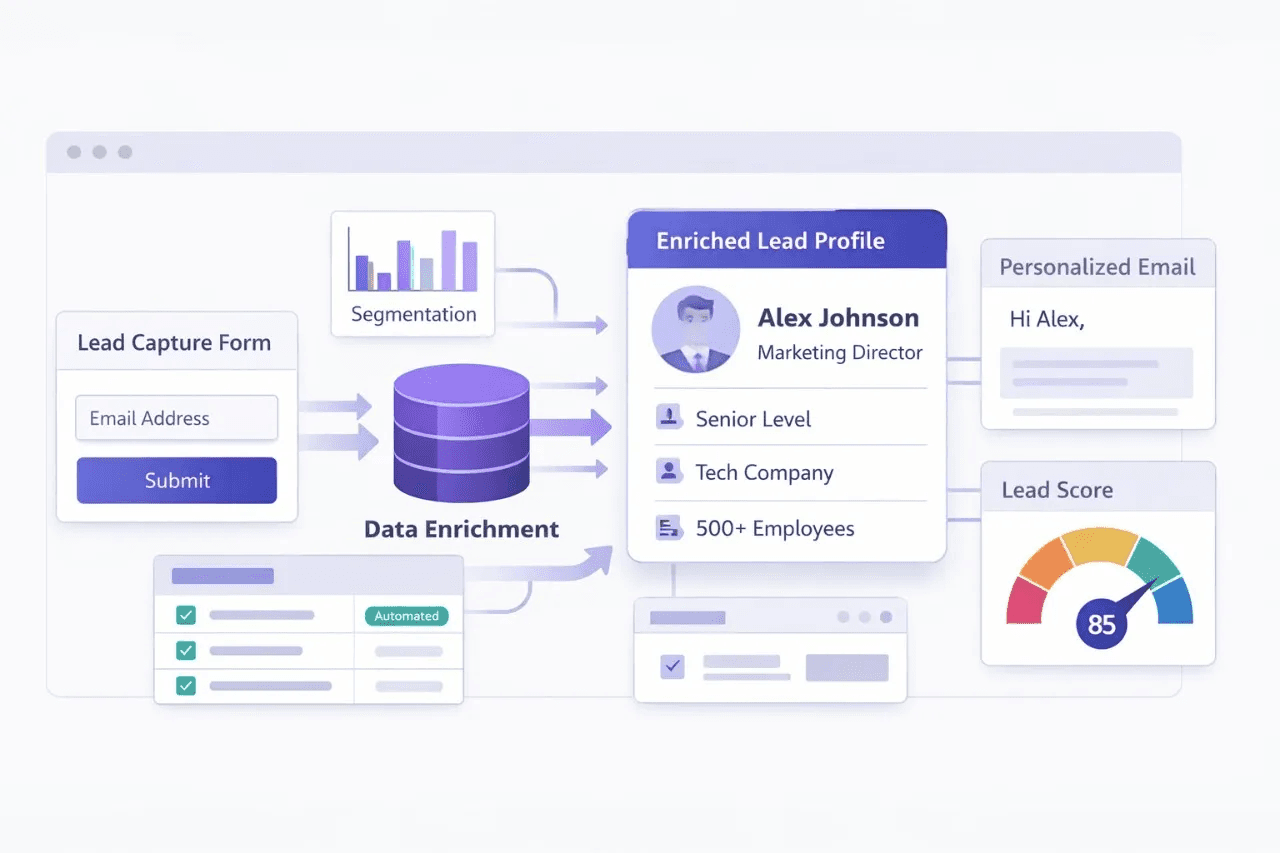
7. Shorter web forms with complete lead profiles. Long forms reduce conversion rates. Enrichment allows marketing teams to capture only an email address and have the platform fill in company, title, seniority, and firmographics automatically in the background. The form converts better. The lead profile is still complete.
8. More precise audience segmentation. Generic "batch and blast" campaigns underperform because every recipient receives the same message regardless of fit. Enriched records carry firmographic and technographic attributes that allow marketers to build tight segments: companies of a certain size, in a specific industry, running a particular technology. Each segment receives messaging that matches its context.
9. Higher personalization quality. Personalized outreach consistently drives significantly higher response and conversion rates compared to generic messaging. Enrichment provides the data attributes that make personalization substantive rather than cosmetic: industry-specific references, technology-aware positioning, and timing tied to actual buyer signals.
10. Improved event and webinar follow-up. Registrants frequently provide personal emails or incomplete company information. Enrichment converts those partial records into full business profiles before the follow-up sequence runs, ensuring the right person is contacted at the correct work address.
11. Better lead scoring accuracy. A lead scoring model built on incomplete data scores incorrectly. Enriched records carry the firmographic and behavioral attributes needed to distinguish a qualified account from an unqualified one, so high-priority leads actually surface at the top of the queue.
12. Tighter sales and marketing alignment. Sales stops trusting the marketing pipeline when leads arrive with wrong phone numbers and missing titles. Enrichment standardizes what a "complete lead" looks like before handoff, reducing the friction between teams that bad data creates.
What Are the Benefits of Data Enrichment for Operations and Leadership?
RevOps and leadership extract a different set of benefits from enrichment, focused on CRM health, territory accuracy, and strategic visibility.
13. Prevention of CRM decay. B2B contact data degrades at roughly 30% per year as people change jobs, companies relocate, and domains change. A database of 10,000 contacts left un-enriched for two years statistically contains thousands of partially or fully outdated records. Continuous enrichment prevents that degradation from compounding.
14. More accurate territory and TAM analysis. Enriched firmographic data makes it possible to map the total addressable market by region, industry, and company size with real precision. Leadership can see where the CRM is under-penetrated, where to allocate headcount, and where marketing spend should concentrate next quarter.
15. Cleaner lead routing. Routing logic depends on attributes like company size, geography, and industry. If those attributes are missing or wrong, leads go to the wrong rep or sit unassigned. Enrichment ensures the attributes that drive routing are present and accurate on every inbound record.
16. AI and automation readiness. Outreach sequences, scoring models, and AI-driven tools are only as good as the data they process. An AI agent working from a record with a stale title and a bad phone number makes errors that damage the brand. High-quality enrichment is the prerequisite for automation that works reliably rather than at random.
17. Competitive positioning through technographics. Knowing what software a prospect runs before the first conversation changes the pitch. A company running a direct competitor gets a displacement message. A company running a complementary tool gets an integration story. A company on legacy infrastructure gets a modernization pitch. Technographic enrichment makes that differentiation systematic rather than accidental.
18. Strategic recruitment. Enrichment is not limited to sales and marketing. Recruiters use direct mobile numbers and personal email addresses to reach passive candidates who are not actively responding to LinkedIn InMail, opening a hiring channel that bypasses the noise of traditional job board outreach.
How Does FullEnrich Help You Realize All 18 Benefits?
Each of the 18 benefits above depends on one condition: the data has to actually be there. A personalization benefit requires a verified job title. A connect rate benefit requires a working mobile number.
A lead routing benefit requires accurate firmographics. When a field is missing, that benefit does not materialize, regardless of how good the downstream process is.
This is where most enrichment programs fall short. A single provider returns complete records on 40 to 60% of a typical B2B list. The rest come back with gaps: a title but no phone, a company but no email, a US contact with strong data and an EMEA contact with almost none. The benefits that depend on those missing fields simply do not fire.
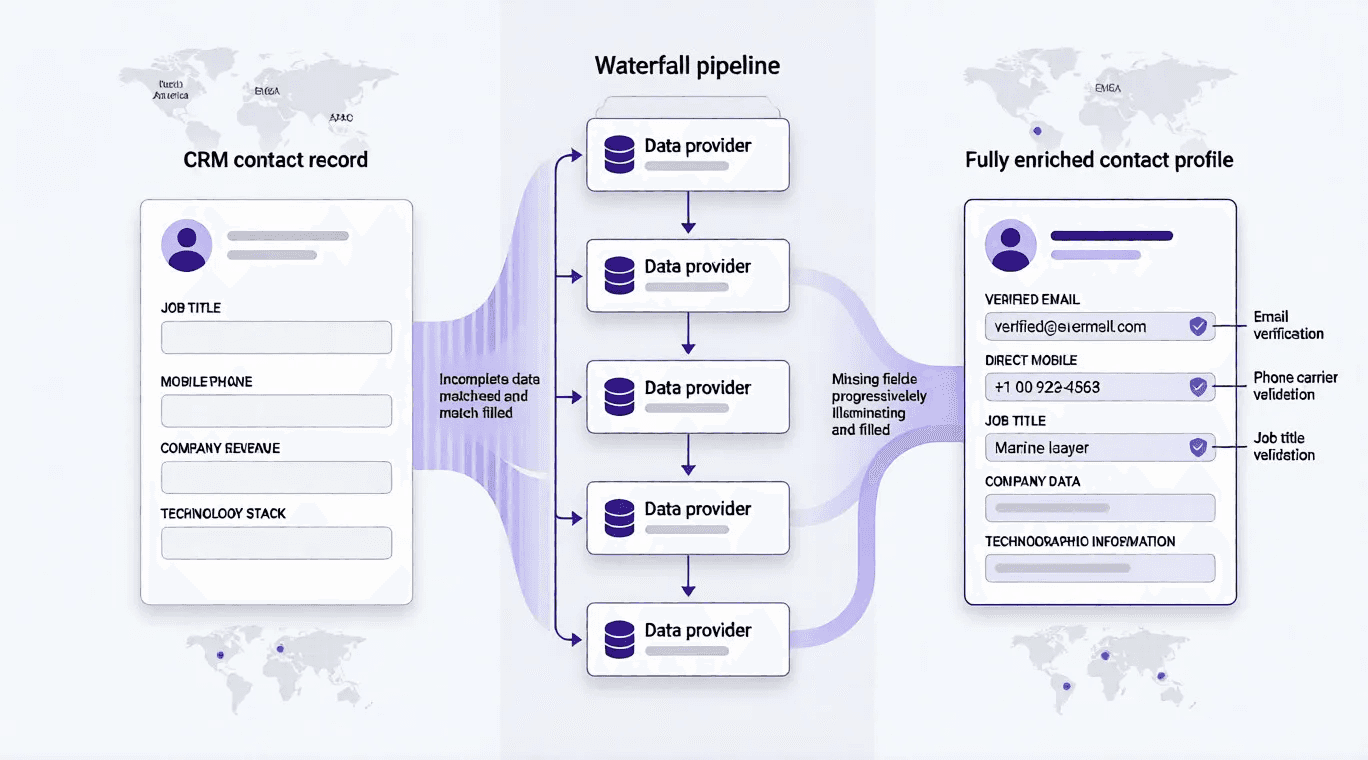
FullEnrich is built around closing that gap. Rather than querying one source and accepting whatever it returns, FullEnrich runs each record through a sequential waterfall of 20+ providers, stopping only when the record is complete or all sources are exhausted.
Each provider is weighted by geography and profile type, so a contact in Germany routes to the strongest EMEA source first, not the same US-centric database that handles North American records. The result is an 80%+ find rate across email and phone, with 89% for US and Canada email, 84% for EMEA, and 78% for LATAM and APAC.
Completeness without accuracy still produces failures. Every result FullEnrich returns passes triple verification: an SMTP handshake confirms the email inbox is live, a carrier check confirms the mobile is active, and job title validation confirms the role against current org structure. A record that passes all three is ready to use without additional manual checking.
The commercial model reflects the same logic. Credits are only consumed on successful enrichments, not on attempts. Annual credits roll over. There are no per-seat fees, so the entire revenue team, sales, marketing, RevOps, and recruiting, works from the same verified data under a single subscription.
For real-time data enrichment at point of capture and bulk CRM contact enrichment of existing databases, FullEnrich covers both without requiring separate tools or separate contracts.
Conclusion
The benefits of data enrichment compound across every function that touches revenue: reps spend more time selling, campaigns reach the right people with the right message, and the CRM remains a reliable system of record rather than a liability of stale data.
Every gap in a contact record is a point where outreach fails, personalization breaks down, or a deal stalls.
FullEnrich delivers 80%+ find rates across 20+ providers, with triple verification on every result and a pay-on-success model that ties cost directly to enrichment that actually works.
Frequently Asked Questions
What is the difference between data enrichment and data cleansing?
Data cleansing removes inaccurate, duplicate, or malformed records. Data enrichment adds missing information to incomplete records. Cleansing corrects what is wrong. Enrichment fills what is absent. Both are required for a healthy CRM, and many enrichment platforms perform both in the same pass.
How often should B2B data be enriched?
Active outbound targets should be re-enriched every 60 to 90 days. B2B contact data decays at roughly 30% per year, which means a record accurate at the start of a quarter may carry a stale title, wrong email, or disconnected mobile by the end of it. High-priority inbound leads should trigger real-time enrichment at point of capture rather than waiting for a scheduled bulk refresh.
Does enrichment work for international prospect lists?
Coverage quality varies significantly by provider and geography. Waterfall enrichment with geographic routing outperforms single-source tools for international lists because it directs each record to the strongest regional provider before continuing the sequence. FullEnrich reaches 84% email find rates for EMEA and 78% for LATAM and APAC.
Is data enrichment GDPR and CCPA compliant?
Compliance depends on the enrichment model. FullEnrich uses fetch-on-demand rather than storing a static warehouse of personal data. Data is retrieved from verified, compliant sources at the time of the enrichment request and is not retained beyond delivery. This approach aligns with GDPR and CCPA requirements around data minimization and on-demand retrieval.
What inputs does enrichment require?
Most platforms accept a name plus company domain, a LinkedIn URL, a work email, or a CSV upload. A LinkedIn URL produces the most precise match. A corporate domain narrows the lookup more effectively than a personal email. Reverse email lookup is also available via API, allowing enrichment to run from a submitted email address as the sole input.
How does enrichment improve lead scoring accuracy?
Lead scoring models score incorrectly when key attributes are missing. A company with 500 employees and $50M in revenue scores the same as a five-person startup if the firmographic fields are blank. Enrichment populates the attributes that scoring logic depends on, so the model distributes scores based on actual account data rather than gaps in the record.
Can enrichment replace a long web form?
Yes. Enrichment enables progressive profiling by allowing marketing teams to capture a single identifier, typically an email address, and append the remaining fields automatically. The form converts at a higher rate because friction is reduced. The lead profile that reaches sales is still complete because enrichment fills the fields the form did not ask for.



Other Articles
Cost Per Opportunity (CPO): A Comprehensive Guide for Businesses
Discover how Cost Per Opportunity (CPO) acts as a key performance indicator in business strategy, offering insights into marketing and sales effectiveness.
Cost Per Sale Uncovered: Efficiency, Calculation, and Optimization in Digital Advertising
Explore Cost Per Sale (CPS) in digital advertising, its calculation and optimization for efficient ad strategies and increased profitability.
Customer Segmentation: Essential Guide for Effective Business Strategies
Discover how Customer Segmentation can drive your business strategy. Learn key concepts, benefits, and practical application tips.