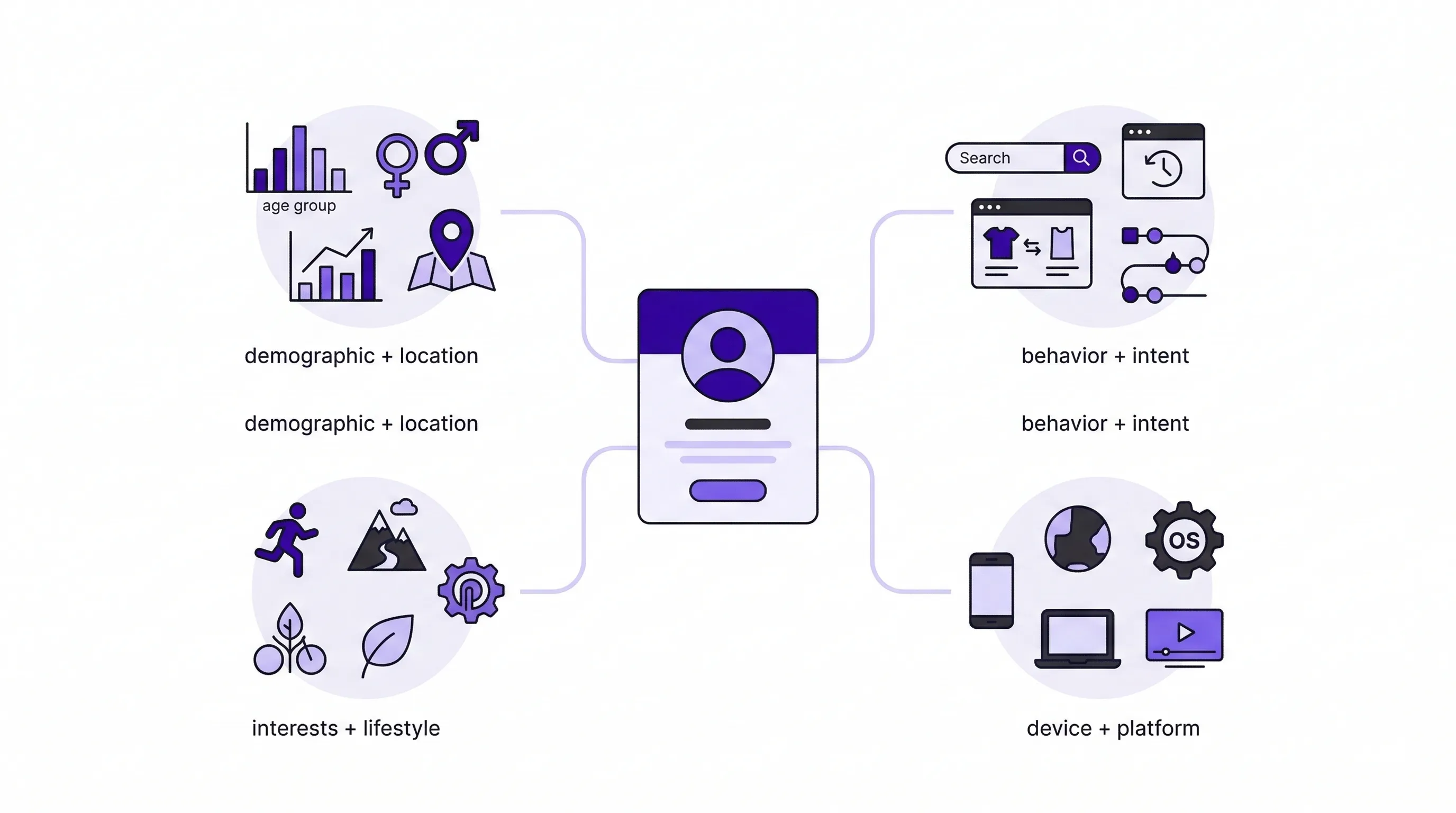

Audience data enrichment layers third-party intelligence onto first-party visitor data to transform anonymous website traffic into targetable segments.
The process appends demographic, behavioral, psychographic, and intent attributes to device identifiers, IP addresses, and cookie data. Identity resolution ties these signals into unified profiles that persist across devices.
Marketers use enriched audiences for personalized campaign messaging, lookalike modeling, lead scoring, and publisher monetization. Where basic analytics tells you someone visited, enrichment tells you who they are, what they want, and what they have purchased before.
What Is Audience Data Enrichment?
Audience data enrichment matches anonymous visitor identifiers against third-party databases to append contextual attributes to otherwise anonymous traffic. When someone lands on your site, enrichment providers query their networks for matching records, then return demographic, behavioral, and psychographic data in real time.
The distinction from other enrichment types matters. Customer data enrichment fills gaps in known CRM contact records by adding phone numbers, job titles, or company data. Audience enrichment operates on anonymous traffic before visitors identify themselves.
The inputs are different (device IDs and IP addresses rather than names and emails) and so are the outputs (segmentation attributes rather than individual contact fields).
The core value exchange is context. A visitor who spends three minutes on a product page tells your analytics one thing. Enrichment tells you they are a homeowner earning above $100K who has been researching similar products across competitor sites for the past week.
That context determines whether to serve a premium offer, a comparison guide, or a retargeting ad on a different channel entirely.
How Does Audience Data Enrichment Work?
Audience data enrichment works by running through four sequential stages: collecting first-party behavioral signals, resolving those signals into unified visitor identities, appending third-party attributes to matched profiles, and activating the enriched segments across marketing platforms.
Each stage feeds directly into the next. Weak signal collection limits identity resolution. Poor identity resolution degrades match accuracy. Low match accuracy produces segments that do not reflect your actual audience.
Understanding where each stage works and where it breaks is what separates enrichment that improves campaign performance from enrichment that adds cost without impact.
First-Party Data Collection
Your tracking pixels, analytics platform, and customer data platform capture behavioral signals: page views, clicks, video engagement, time on page, and conversion events. These generate identity signals, including hashed emails, device IDs, IP addresses, and cookie data, that enrichment providers use as matching inputs.
The implementation method affects match rates. Server-side integrations pass data directly between platforms without browser limitations. Client-side tags face ad blockers and privacy restrictions that reduce the volume of usable signals.
Teams running client-side tagging on high-traffic sites often see meaningful gaps between actual visitors and enrichable records.
Identity Resolution and Matching
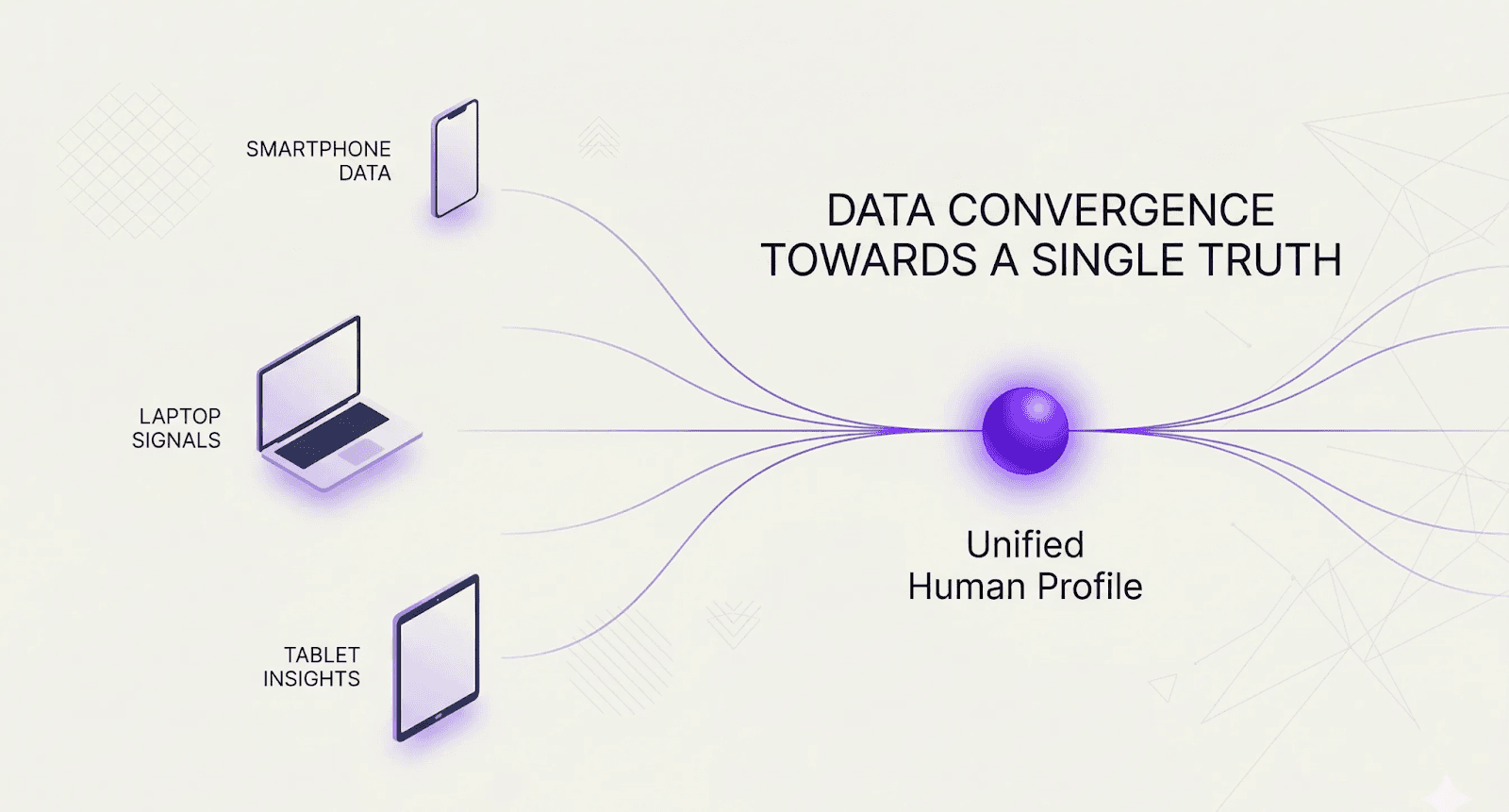
Identity graphs connect fragmented signals into unified profiles. A single visitor browsing on mobile, returning from desktop, and converting on tablet gets recognized as one person rather than three separate visitors.
Without identity resolution, enrichment appends attributes to device-level fragments rather than person-level profiles, producing redundant and conflicting data.
Two matching methods handle different populations. Deterministic matching uses exact identifiers such as verified email addresses and authenticated login IDs, achieving 90–95% accuracy. It works only for authenticated users, typically 10–20% of total traffic.
Probabilistic matching infers connections from patterns across shared IPs, sequential device usage, and overlapping browsing behavior, reaching 60–80% accuracy across anonymous traffic. Most enrichment implementations use both, applying deterministic logic to authenticated sessions and probabilistic methods to unidentified visitors.
Third-Party Data Appending
Enrichment providers maintain databases linking identifiers to audience attributes. Your first-party identifier queries their network. Matching records return demographics, interests, purchase history, and propensity scores. The breadth and recency of these databases directly determine match rates and attribute accuracy.
Waterfall enrichment queries multiple providers sequentially, using the first to return a verified result and cascading to alternatives when primary sources lack coverage.
This approach consistently produces higher match rates than single-provider enrichment, particularly for international audiences, privacy-focused users, and niche demographics that any single database covers incompletely.
Segmentation and Activation
Enriched data organizes into targetable audience segments: high-income homeowners showing purchase intent for home improvement, mobile users researching budget options, or B2B decision-makers consuming competitor content.
These segments sync to ad platforms, email tools, and personalization engines through API connections.
Real-time activation enables immediate personalization. A visitor landing on a product page gets served creative relevant to their income bracket and previous purchase behavior within the same session.
Batch processing handles campaign planning and audience building for scheduled outreach where real-time response is not required.
What Types of Data Does Audience Enrichment Cover?
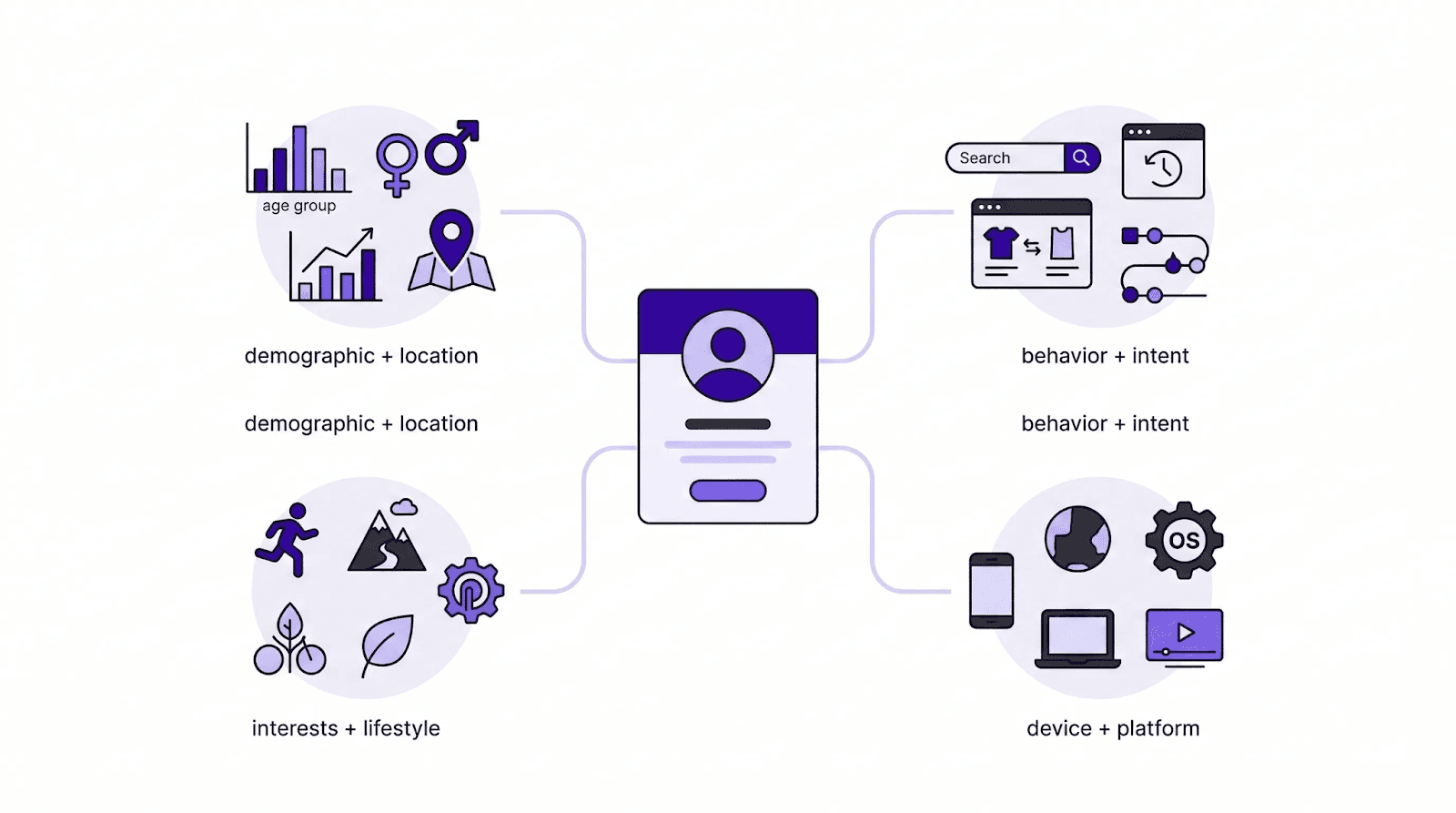
Different data categories serve different marketing objectives. Teams should select enrichment types that match specific use cases rather than appending every available attribute.
Demographic data covers age, gender, income, education level, and household composition. It enables basic exclusion logic (no luxury messaging to student demographics) and messaging calibration based on life stage. Geographic precision extends beyond city-level to neighborhood-level attributes, distinguishing urban apartment dwellers from suburban homeowners within the same metro area.
Behavioral and intent data includes content consumption patterns, search behavior, product comparison activity, and cross-device browsing history. Purchase intent indicators identify prospects actively researching a category, enabling time-sensitive targeting when buying consideration is highest. Cross-device behavioral data guides channel strategy by revealing how audiences move between smartphones, desktops, and connected TV throughout their decision process.
Psychographic and lifestyle attributes classify audiences by interests, values, and activities. Fitness enthusiasts, outdoor adventurers, early technology adopters, and environmentally conscious consumers represent lifestyle segments that predict product affinity more accurately than demographics alone. Purchase propensity scores estimate likelihood of buying a specific product category, allowing teams to separate high-probability conversion targets from audiences requiring longer nurture.
Technographic data covers device ownership, operating system preferences, and platform usage patterns. iOS versus Android splits, premium versus budget device ownership, and streaming platform subscriptions all inform creative format decisions, app development priorities, and competitive positioning.
What Are the Benefits of Audience Data Enrichment?
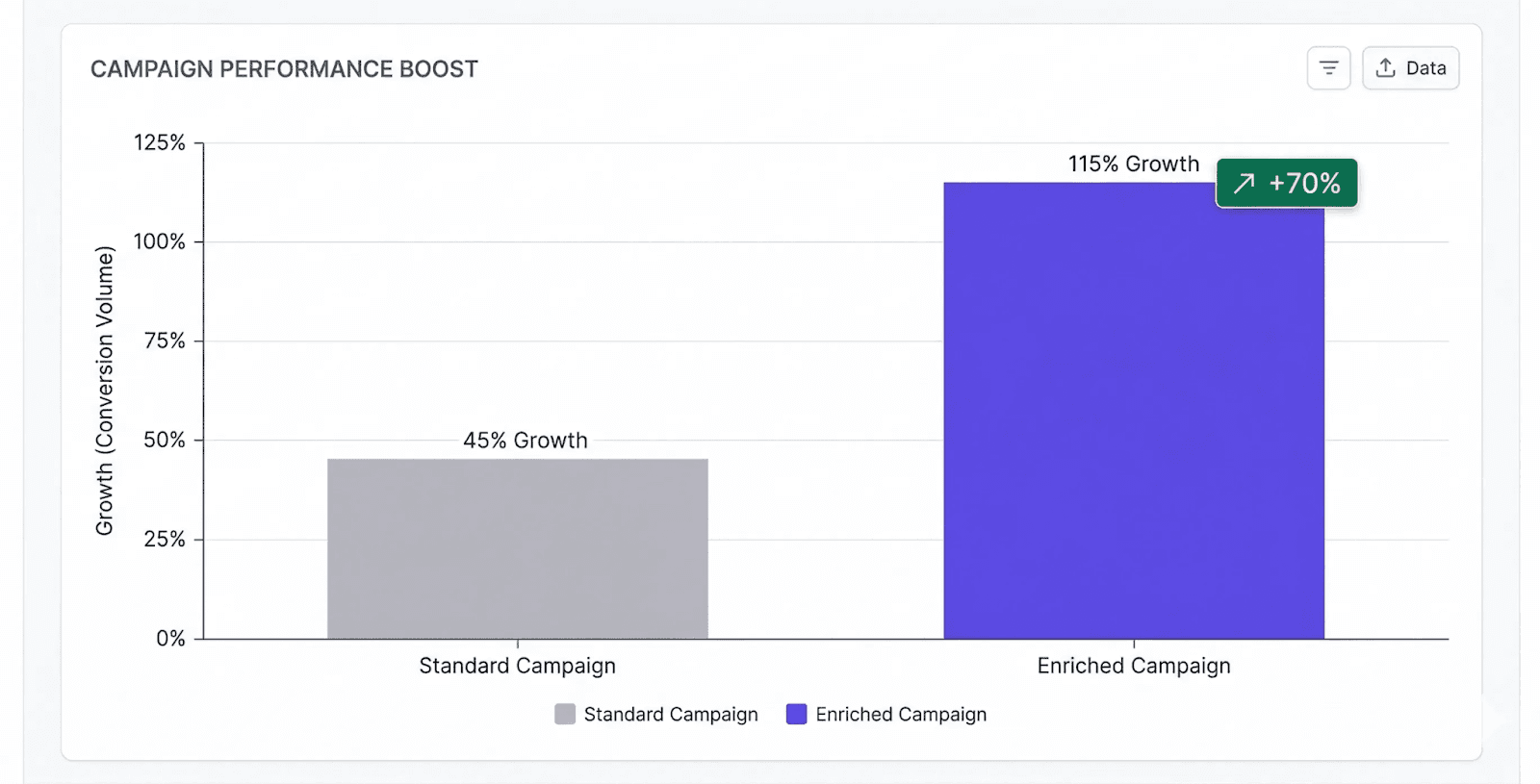
When marketers know who their visitors actually are, rather than just what pages they visited, every downstream decision improves. Campaigns reach the right people, budgets stop leaking toward unqualified traffic, and messaging becomes specific enough to drive action.
According to a 2024 survey by Leadpages, teams that implemented data enrichment strategies observed an 11–30% lift in conversion rates. The underlying reason is straightforward: enrichment replaces assumption with verified audience intelligence at every stage of the campaign workflow.
The core benefits break down across five areas:
Targeting precision. Instead of targeting broad brackets like "women 25-45," enrichment lets teams isolate specific sub-segments, such as high-income professional women who engaged with leadership content in the past 30 days and have not yet converted. Negative targeting works the same way. Excluding recent purchasers, competitor employees, and low-intent researchers from an audience reduces wasted impressions without shrinking reach among genuinely qualified prospects.
Personalization backed by data. According to McKinsey research, 71% of consumers expect personalized interactions from the brands they engage with. Enrichment provides the underlying attributes, income level, device type, purchase history, interest signals, that allow marketing content to reflect each visitor's actual context rather than a generic profile. According to Instapage, personalized calls-to-action convert at 202% higher rates than generic ones, precisely because the offer matches what the visitor already cares about.
Lower customer acquisition costs. Research from Demand Local shows that data enrichment reduces customer acquisition costs by 12% on average. Concentrating ad spend on segments that show relevant behavioral and demographic signals means fewer wasted impressions on visitors who were never going to convert.
More accurate lookalike modeling. Unenriched seed audiences replicate surface-level traits like age range without capturing what actually drives conversion. Enrichment exposes the behavioral and psychographic patterns that predict purchase, producing lookalike models that find genuinely similar prospects rather than demographic near-matches.
Publisher revenue uplift. Enrichment proves audience composition to programmatic buyers. Verified segments of high-income households or in-market shoppers command higher CPMs than anonymous inventory, shifting publisher revenue from volume-based to quality-based pricing.
How to Build an Effective Audience Data Enrichment Workflow?
An effective enrichment workflow starts with a defined objective and ends with a measurement framework. Without both, teams collect data that sits unused and spend budget with no way to prove return.
Define the use case first. Retargeting needs behavioral and intent signals. Lookalike expansion needs demographic and psychographic attributes. Content personalization runs on interest signals. The data type follows the objective, not the other way around.
Set quality thresholds before going live. Test enrichment accuracy against known customer records before scaling. Acceptable minimums are match rates above 60% for probabilistic matching and above 90% for deterministic, with attributes updated quarterly at minimum. Providers that cannot show transparent sourcing documentation introduce compounding accuracy risk.
Connect enrichment across the full stack. Enrichment that reaches only one platform wastes the investment. Ad platforms, email automation, personalization engines, and analytics systems all need access to the same enriched segments through automated data flows, not manual exports.
Audit providers for compliance before signing. GDPR, CCPA, and state privacy laws require consent management, data minimization, and opt-out processing within required timeframes. Non-compliant enrichment creates legal exposure that outweighs any targeting gain.
Measure at the segment level, not in aggregate. Establish baseline conversion rates and cost per acquisition before implementation. After enrichment runs, identify which data types improve performance, which add no value, and which segments no longer justify the cost. Stop enriching what does not work.
What are common Implementation Challenges?
Audience data enrichment hits four predictable obstacles that teams should account for before committing a budget.
Incomplete match coverage. No provider matches all traffic. Anonymous visitors, ad blocker users, and international audiences create gaps, with match rates typically ranging from 40–70% for anonymous traffic. Waterfall enrichment across multiple providers closes the gap but adds cost.
Identity resolution errors. Probabilistic matching misattributes characteristics when household IPs are shared or users switch between devices. Set match thresholds based on what a wrong conversion actually costs, not on maximizing coverage volume.
Integration complexity. API connections require engineering resources and ongoing maintenance that teams routinely underestimate. Budget for this before signing a contract.
Cost accumulation. Licensing, API calls, and processing fees compound fast across large audiences. Restrict enrichment to high-value segments and calculate cost per incremental conversion regularly.
How FullEnrich Supports Audience and Contact Enrichment?
FullEnrich operates a waterfall enrichment architecture across 20+ premium data providers, sequencing sources until a verified match is returned or coverage is exhausted. Find rates reach 89% for US emails and 86% for US mobile phones, with EMEA coverage at 84% email and 71% phone, LATAM at 78% email and 67% phone, and APAC at 78% email and 66% phone.
For teams running inbound or content-driven programs, FullEnrich enriches contact records captured through forms and gated content, appending job title, seniority, company firmographics, and verified contact fields before records reach sales queues.
Triple email verification against live mail server records produces bounce rates under 1%. Credits are charged only on successful enrichment. Failed lookups consume no budget. There are no seat fees or per-user licensing costs.
Data is fetched on demand with no persistent storage of personal contact records, maintaining alignment with GDPR, CCPA, and SOC 2 Type II compliance requirements.
Conclusion
Audience data enrichment transforms anonymous website traffic into targetable intelligence by appending demographic, behavioral, psychographic, and intent attributes to first-party visitor data. It enables targeting precision, personalization depth, and lookalike modeling that generic analytics cannot support.
Effective implementation requires clear use cases, enforced quality thresholds, privacy-compliant provider selection, and cross-platform integration. Measure against pre-enrichment baselines at the segment level, discontinue enrichment for audiences that show no incremental return, and prioritize waterfall architecture for international or niche segments that single-source databases cover poorly.
Frequently Asked Questions
What is the difference between customer data enrichment and audience data enrichment?
Customer enrichment enhances known contact records in your CRM by adding missing fields like phone numbers, job titles, and company data. Audience enrichment classifies anonymous website visitors into targetable segments before those visitors identify themselves. Different inputs, different data types, different use cases.
How accurate is audience data enrichment?
Accuracy depends on the matching method. Deterministic matching using verified identifiers like email addresses achieves 90–95% accuracy but only applies to authenticated users, typically 10–20% of traffic. Probabilistic matching infers connections from behavioral patterns and covers anonymous traffic at 60–80% accuracy. Most implementations use both methods across different visitor populations.
Does audience enrichment work after cookie deprecation?
Modern enrichment uses identity resolution methods that do not depend on third-party cookies: first-party authenticated data, hashed emails, contextual signals, and server-side matching techniques. Providers that invested in cookie-less infrastructure maintain targeting effectiveness where competitors relying on deprecated methods face coverage degradation.
What privacy regulations affect audience enrichment?
GDPR, CCPA, and applicable state privacy laws require consent management, data minimization, and user opt-out processing within required timeframes. Compliant enrichment respects these requirements through privacy-first matching architectures and clear data provenance documentation. Non-compliance creates legal liability that exceeds targeting benefits.
How do you measure enrichment success?
Establish pre-enrichment baselines for conversion rate, cost per acquisition, and return on ad spend by segment. Compare segment-level performance post-enrichment rather than aggregate metrics. Identify which enriched attributes drive incremental improvement, which add no value, and which segments generate sufficient ROI to justify continued investment.
What is waterfall enrichment?
Waterfall enrichment queries multiple data providers sequentially, using the first to return a verified result and passing unmatched records to the next provider in the sequence. This produces higher match rates than single-source enrichment, particularly for international audiences and niche demographics that individual databases cover incompletely.
Can small businesses benefit from audience enrichment?
Yes, particularly when targeting precision matters more than reach. Businesses with specific target audiences, higher average order values, or longer sales cycles see positive returns even at limited traffic volumes because enrichment concentrates spend on high-probability segments rather than distributing it across unqualified visitors.
How long does enrichment implementation take?
API connections and platform configurations typically require two to eight weeks depending on your existing technology stack. Additional time is needed for segment definition, campaign strategy development, and baseline measurement setup before performance comparisons are meaningful.



Other Articles
Cost Per Opportunity (CPO): A Comprehensive Guide for Businesses
Discover how Cost Per Opportunity (CPO) acts as a key performance indicator in business strategy, offering insights into marketing and sales effectiveness.
Cost Per Sale Uncovered: Efficiency, Calculation, and Optimization in Digital Advertising
Explore Cost Per Sale (CPS) in digital advertising, its calculation and optimization for efficient ad strategies and increased profitability.
Customer Segmentation: Essential Guide for Effective Business Strategies
Discover how Customer Segmentation can drive your business strategy. Learn key concepts, benefits, and practical application tips.